Mastering AI Search Engine Optimization a Practical Guide
So, what exactly is AI Search Engine Optimization?
At its core, it’s the art and science of getting your content featured—and more importantly, cited—within the AI-generated answers popping up in search results. Think Google’s AI Overviews or a response from ChatGPT. We're moving past the classic list of blue links. The new goal is to become such a trusted source that AI models single you out and use your information to build their answers.
It’s like getting a direct endorsement from the search engine itself.
Welcome to the New Era of Search
Let's be blunt: the old SEO playbook is getting a major rewrite. The Google we all grew up with, the one that felt like a giant digital library, is evolving. It's becoming a smart, conversational partner, and AI is the engine driving it all. This shift ushers in the age of AI Search Engine Optimization, which some are calling Generative Engine Optimization (GEO).
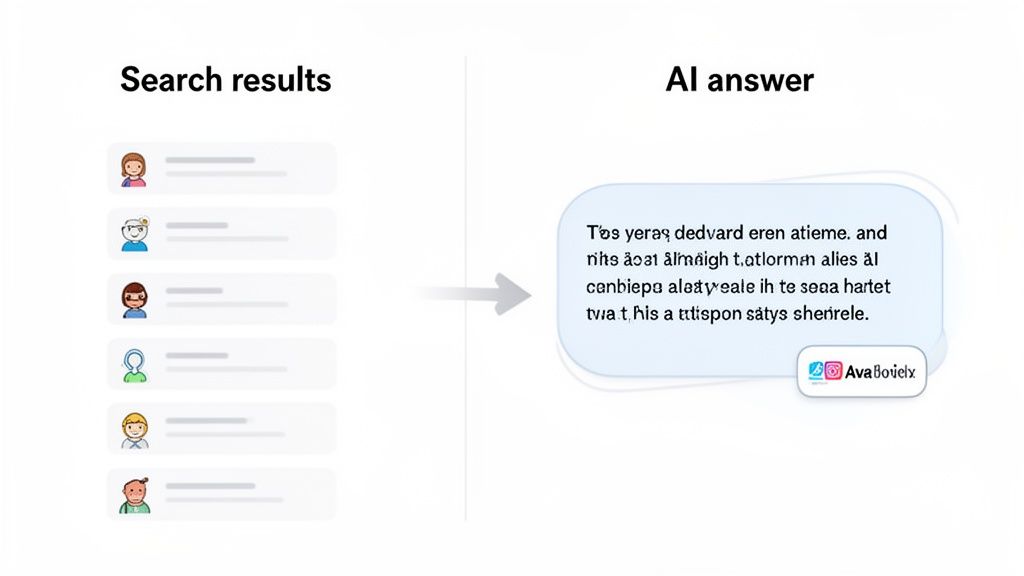
This isn't just another think piece filled with vague predictions. This is your battle plan for navigating this new frontier. AI models are actively writing your brand's story for millions of people, pulling information from every corner of the web to answer complex questions in real time.
The big question isn't "How do I rank number one?" anymore. It’s "How do I shape the AI's answer?"
Shifting from Clicks to Citations
The entire game has changed. Traditional SEO has always been about visibility—chasing rankings, earning clicks. But AI search engine optimization is a game of influence. The new currency is citations and brand mentions inside the AI-generated response.
Your brand is no longer just a result on a page; it's a source for a definitive answer. Success means becoming so reliable that the AI presents your information as fact.
This move from a simple keyword-and-click model to a more complex trust-and-influence one demands a whole new mindset. Let’s break down the shift.
| Aspect | Traditional SEO | AI Search Engine Optimization (GEO) |
|---|---|---|
| Primary Goal | Rank #1 on the results page | Become a cited source in the AI answer |
| User Interaction | User types keywords, clicks a link | User asks a question, gets a direct answer |
| Core Metric | Clicks, impressions, keyword rankings | Citations, brand mentions, prompt influence |
| Optimization Focus | Keywords and backlinks | Answering prompts and building trust signals |
| Content Strategy | Create content around target keywords | Create comprehensive, data-rich content |
As you can see, the focus is moving away from just winning the keyword game. Now, it's about providing the most authoritative, clear, and trustworthy information that an AI can confidently reference. It's a much deeper level of optimization.
A New Tactical Framework
Winning here means you have to think differently about how you create and structure information.
- From Keywords to Prompts: People are talking to search engines now, asking long, conversational questions. Your content needs to provide direct, thorough answers to those very prompts.
- From Backlinks to Trust Signals: Backlinks aren't going away, but AI models are looking for a whole lot more. They're weighing things like data accuracy, expert consensus, and whether you're featured in other high-authority sources.
- From Web Pages to Knowledge Snippets: AI systems don’t just read your page; they deconstruct it. They break your content down into bite-sized facts and data points. Your job is to make those snippets as clear and easy for them to grab as possible.
This guide will give you the framework to turn this enormous shift into your biggest competitive advantage. We’ll get into the weeds of what AI search really is, why it’s a non-negotiable channel for growth, and how you can start taking control of the narrative.
By mastering these new rules, your brand won't just survive—it'll become the AI's go-to expert. And for that, you’ll need the right intelligence, which is where platforms like Kruxel come in, designed specifically to help you make sense of this new landscape.
So, What Exactly Is AI Search Engine Optimization?
Let's cut through the noise. If traditional SEO was about building the perfect resume to get past a company's screening software, AI Search Engine Optimization is like sitting down for the final interview with the CEO. It’s no longer enough to just stuff the right keywords in the right places. Now, you have to present your information so clearly and with such authority that a powerful AI chooses you as the definitive source for its answers.
Picture the new AI search models as brilliant, hyper-efficient research assistants working for the entire world at once. They have to sift through a mind-boggling amount of data to deliver one perfect, concise answer. Your new job? Become their most trusted, go-to expert for your topic.
This changes the game completely. We're not just fighting for clicks from a list of blue links anymore. The new win is seeing your brand cited and featured directly inside an AI-generated response. This is the heart of what many are calling Generative Engine Optimization (GEO).
From Keywords to Conversations
The first huge mental shift is moving from stiff, predictable keywords to the fluid, natural way people actually talk. Nobody just types "best running shoes" anymore. They ask, "What are the best running shoes for a beginner with flat feet who mostly runs on pavement?"
This means our content has to evolve. Forget optimizing a page for a single keyword. You now need to build a comprehensive resource that anticipates and directly answers the detailed, multi-layered questions your audience is asking.
- Think one step ahead: What's the next question they'll have? Build that answer right into your content.
- Write like a human: AI models learn from human conversation. Overly robotic, keyword-crammed text is a major red flag for them.
- Get to the "why": Look past the words to understand what the user truly wants to accomplish. Are they just browsing, comparing options, or are they ready to pull out their credit card?
From Backlinks to Verifiable Citations
For decades, backlinks were the currency of SEO authority. They're still part of the equation, but AI models are now looking for a much wider range of trust signals. Think of it as the difference between a popularity contest and a peer-reviewed scientific journal. It’s not just about who links to you, but about whether your claims can be verified.
In the new world of AI search, a citation is way more than a link—it's a stamp of approval. When an AI engine cites your content, it’s publicly declaring, "This is a factually accurate and trustworthy source of information."
This means your content needs a rock-solid foundation of provable facts, hard data, and expert consensus. You have to be the primary source, not just another site echoing what everyone else is saying. It's why platforms like Kruxel are becoming so critical; they track these citations, showing you exactly which AI models are using your information and where you stand in this new ecosystem.
From Ranked Pages to Featured Answers
The holy grail of old-school SEO was hitting that number one spot. In AI search, the new pinnacle is becoming a fundamental piece of the AI-generated answer itself. You’re no longer just a stop on the user's journey—you are the destination.
This is a massive change in how we need to think about creating content. Every single piece you publish, from a blog post to a product page, has to be structured so an AI can easily pull it apart and use the pieces.
You need to start thinking in "knowledge snippets"—small, self-contained chunks of information that an AI can grab and reassemble into a perfect answer. This means getting practical about:
- Smart Headings: Use your H2s and H3s to break down big topics into logical, bite-sized sections.
- Structured Data: Use schema markup to literally tell search engines what your content is. Is it a product? A review? A recipe? Don't make them guess.
- Factual Precision: Every number, statistic, and claim needs to be dead-on accurate and, whenever possible, linked back to an authoritative source.
Getting this right isn't just about tweaking a few things; it requires a whole new mindset. But once you truly grasp these core shifts—from keywords to prompts, backlinks to citations, and pages to answers—you’ll be taking the first and most important step toward winning the future of search.
The Four Pillars of a Winning GEO Strategy
Alright, let's get from theory to practice. A winning AI search strategy isn't something you just stumble into. It’s built on four core pillars that all work together to convince an AI that you are the most reliable source of information on the block.
Think of it like building a house. You need a solid foundation, strong walls, clean wiring, and a great reputation in the neighborhood. If you skimp on any one of those, the whole thing gets shaky. The same rules apply here.
This framework breaks down the seemingly massive task of Generative Engine Optimization (GEO) into four straightforward, manageable parts. Let's dig in.
Pillar 1: Authoritative Content Creation
First up is the bedrock of everything you'll do: creating content that's so factual, clear, and well-organized that AI models can't help but see it as gospel. This is more than just writing a good blog post; it's about engineering information for a machine to understand and trust.
The goal here is simple: become the primary source. AI systems are programmed to find and favor content that offers up verifiable facts and gives straight, unambiguous answers. That means every article, guide, or product page needs to be written for two audiences at once: your human readers and the AI crawlers.
Here's what that looks like in practice:
- Verifiable Data: Every statistic and claim needs to be accurate. If you can, link out to the original source to prove it.
- Clear Structure: Use logical headings (H2s, H3s) to chop up complex topics into bite-sized pieces that are easy to follow.
- Direct Answers: Think about the conversational questions people are asking and frame your content to answer them head-on.
Pillar 2: Prompt and Citation Analysis
If content is your foundation, this pillar is your spy network. You can't win a game without knowing the score or who you're up against. This is how you start mapping out the AI search battlefield.
It’s all about using specialized tools to figure out the exact prompts your audience is feeding into AI engines. Even more important, it shows you which of your competitors are getting cited in the answers. Suddenly, you have a crystal-clear map of your biggest opportunities and threats.
Think of this as your reconnaissance mission. You're trying to understand the AI's current "brain" on your topic, pinpointing the content gaps you can fill to knock out competitors and become the new source of truth.
The money behind getting this right is staggering. The AI-powered SEO market is on track to hit $67 billion by 2025, rocketing ahead with a 22% compound annual growth rate. And while 86% of SEO pros are using AI in their work, a massive 74.3% of marketers aren’t even thinking about creating content specifically to get AI citations. That’s a huge competitive advantage for anyone who gets in now. You can learn more about these AI SEO statistics and the market opportunity.
This diagram gives you a simple look at how your content gets from your site to the user through an AI.
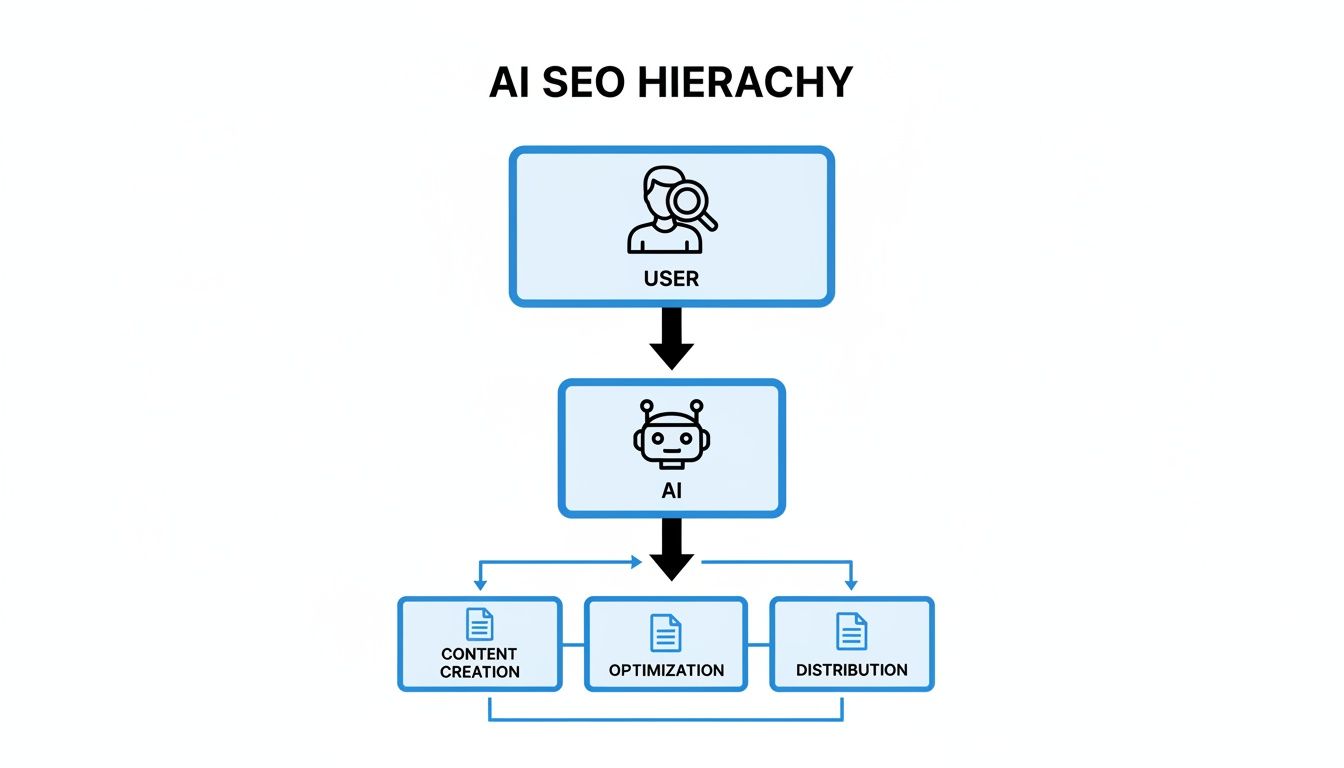
What this shows is a critical fact: your content is literally the raw material the AI uses to build an answer for someone.
Pillar 3: Technical Trust Signals
This third pillar is the technical wiring running behind the scenes of your website. It’s constantly sending little signals of credibility to AI models, making sure your site’s backend is as clean and trustworthy as the content on the front end.
AI models lean heavily on these technical cues to check if you're legit. A beautiful website with sloppy, confusing code is like a person in a sharp suit who can't string a sentence together—it just feels off.
You need to nail these three things:
- Structured Data (Schema Markup): This is like putting little labels on your content that tell an AI exactly what it's looking at—this is a product, that's a price, this is an author. It eliminates all the guesswork for the machine.
- Robust E-E-A-T Signals: Show off your Experience, Expertise, Authoritativeness, and Trustworthiness. This means clear author bios, credentials, and links to other respected places you've been featured.
- Clean Semantic HTML: Use your HTML tags correctly. This defines the structure and meaning of your content, making it a breeze for machines to read and understand.
Pillar 4: Targeted Digital PR and Outreach
Finally, the fourth pillar is all about trust by association. It’s not enough to just say you’re an expert; you need other experts to back you up. In the world of GEO, this means getting your brand and content featured on websites that AI models already see as highly authoritative.
This isn't about chasing a million low-quality backlinks. It's a surgical campaign to land placements, mentions, and links from a hand-picked list of top-tier industry blogs, news outlets, and research sites.
Every time you get placed on a trusted domain, it sends a powerful ripple through the network. It signals to AI models that the rest of the expert community thinks your information is solid, creating a web of credibility that cements your status as a go-to source. Platforms like Kruxel can help you find these high-authority domains, turning your outreach from a shot in the dark into a data-driven strategy.
Measuring Success in the Age of AI Search
So, how do you actually prove your AI search engine optimization efforts are paying off? Let's be honest, the old-school scorecards we've leaned on for years—the ones obsessed with keyword rankings and click-through rates—are starting to feel like relics from a bygone era. In a world where winning means getting your brand cited inside an AI's answer, your metrics need a serious upgrade.
The game has changed, and so has the definition of "winning." It’s time to ditch the vanity metrics and start tracking the numbers that tie your strategy directly to what the business actually cares about: results. This is how you show your team and the people holding the purse strings that this stuff works.
Moving Beyond Rankings and Clicks
For years, SEO reports revolved around two simple questions: Did we rank higher? Did we get more clicks? While those numbers aren't totally useless, they don't even begin to tell the full story of AI search. Think about it: your brand could be name-dropped ten times in an AI Overview, driving massive awareness and purchase intent, without a single traditional "click" ever being recorded.
This new reality demands a new way of measuring. We need to start tracking our influence on the AI's conversation, not just our position on some static list. That means getting comfortable with a fresh set of KPIs built specifically for this generative age.
In the world of Generative Engine Optimization (GEO), success isn't just about being seen—it's about being cited. The ultimate goal is to become so authoritative that the AI uses your brand's information to construct its answers for millions of users.
To do this, you need tools built for this new landscape. Platforms like Kruxel are designed to give you a peek inside that "black box," helping you monitor the vital new metrics that prove your strategy is hitting the mark.
Your New Core KPIs for AI Search
To get a real sense of your impact, you have to start tracking how your brand shows up inside AI-generated responses. This is where the true value of your AI search engine optimization strategy shines. Your new dashboard should be built around these three critical areas.
Share of Prompt: Think of this as your market share in the AI world. It measures how often your brand is cited for a specific set of high-value conversational prompts compared to your competitors. A high Share of Prompt means you're basically owning the AI's understanding of your industry.
Citation Volume: This one is straightforward but incredibly powerful. It’s a simple count of how many times your brand, products, or content are mentioned across different AI platforms like ChatGPT, Perplexity, and Google's AI Overviews. If this number is going up, it’s a crystal-clear sign your authority is growing.
Brand Sentiment: This metric goes a step deeper by analyzing the context of your citations. Is the AI talking about you in a positive, neutral, or negative way? Tracking sentiment helps you understand how the AI perceives your brand and gives you a chance to jump on any narrative issues before they snowball.
Connecting GEO Efforts to Revenue
At the end of the day, every marketing effort has to link back to the bottom line. The great news is that the payoff for getting this right is enormous. The data shows that AI search traffic converts at an incredible 14.2%, which absolutely demolishes the 2.8% conversion rate from traditional Google organic traffic.
This is amplified by the sheer scale of platforms like ChatGPT, which now has 800 million weekly active users. AI platforms drove 1.13 billion referral visits in June 2025 alone—a staggering 357% jump from the previous year—with ChatGPT sending half of that traffic. You can dig into more of these fascinating AI search traffic statistics yourself.
By using a dedicated GEO platform to keep a close eye on your Share of Prompt and citation volume, you can draw a straight line between your optimization work and tangible business growth. This gives you the hard data you need to justify your budget and prove that investing in AI search engine optimization isn't just a defensive move; it's one of the smartest offensive plays you can make right now.
Real World Examples of AI SEO in Action
Alright, enough with the theory. Let's get down to brass tacks and see what this looks like in the wild. It’s one thing to talk about frameworks and another to see how real brands are actually winning the AI search game.
These aren't just made-up scenarios. They're based on the exact kinds of problems we see every day, showing how smart, targeted strategies can pull a brand back from the brink. We'll dive into two stories: an e-commerce shop that got ghosted by AI and a SaaS company that was being written out of its own story by a competitor.
The E-Commerce Brand That Disappeared Overnight
Picture this: a fantastic online store selling high-end, artisanal coffee beans. They’d done everything right with traditional SEO, ranking well for classic keywords like "buy single-origin coffee." Then, Google's AI Overviews rolled out, and poof—they were gone. Shoppers asking "best coffee for a french press" or "what’s a good dark roast for espresso?" got an instant AI answer, and their brand was nowhere in sight.
So what went wrong? Their product descriptions were beautiful, full of rich storytelling and tasting notes. But they were selling a vibe, and the AI models were hungry for hard data.
The Fix:
They fired up their GEO platform and pinpointed the top 20 prompts that actually lead to sales in their niche. Armed with this intel, they gave their product pages a complete makeover, transforming them into the kind of source an AI would trust implicitly.
- No-Nonsense FAQs: They added a straightforward FAQ section to every product page. Suddenly, questions like, "What is the roast level of this bean?" and "Is this coffee good for cold brew?" had direct, factual answers.
- Data-First Descriptions: They didn't ditch their brand voice, but they layered in the specs. Every description now included concrete details like roast date, the altitude the beans were grown at, specific flavor notes (think "notes of dark chocolate and cherry"), and the best brewing methods.
- Signposting with Schema: They used detailed Product and FAQ schema markup. This was like putting up neon signs for search engines, clearly labeling all the new information and leaving nothing to interpretation.
The results were almost immediate. Within a few weeks, their products started popping up directly in AI Overviews for those high-value questions. They weren't just another blue link anymore; they were the AI's direct recommendation. You can bet their sales numbers noticed.
The SaaS Company Fighting to Reclaim Its Narrative
Now for a different battle. We have a B2B SaaS company, a long-time leader in project management software. A deep dive using a platform like Kruxel uncovered a chilling trend. A newer, scrappier competitor was absolutely dominating the citations for critical prompts like "best project management software for small teams."
The AI was essentially learning about the market from their rival's content, rewriting the industry narrative to frame them as the default choice. Every single day they did nothing, the competitor’s authority was being baked deeper into the AI's brain.
This is the new competitive battlefield. Your rival doesn't just outrank you; they can become the AI's chosen expert, effectively erasing your brand from the conversation for high-intent buyers.
The Counter-Attack:
They launched a two-pronged assault, hitting both content and outreach hard.
- Becoming the Definitive Resource: They created a massive "Ultimate Guide to Project Management Software." It wasn't just a sales pitch; it was an exhaustive, objective comparison of features, pricing, and use cases across the entire industry—and yes, they included their competitor. This move instantly positioned them as a trustworthy educator, not just another vendor.
- Strategic Digital PR: Next, they identified the top 10 industry blogs and software review sites that AI models consistently trusted and cited. Their outreach team went into overdrive, securing guest posts, getting mentioned in articles, and providing expert quotes on these high-authority sites, always linking back to their new ultimate guide.
This one-two punch systematically built a web of trust signals all pointing back to their brand. Before long, AI models started recognizing them as a more credible, comprehensive source than their rival. In just one quarter, they knocked the competitor out of the top citations, reclaiming their rightful place and capturing a huge wave of top-of-funnel traffic.
Your 90-Day AI Search Engine Optimization Action Plan
Alright, enough theory. Let's get our hands dirty.
Knowing what to do is one thing, but actually doing it is what gets you paid. This 90-day plan is your practical, no-fluff roadmap for getting started with AI search engine optimization. We're going to build momentum, grab some early wins, and lay a killer foundation for the long haul.
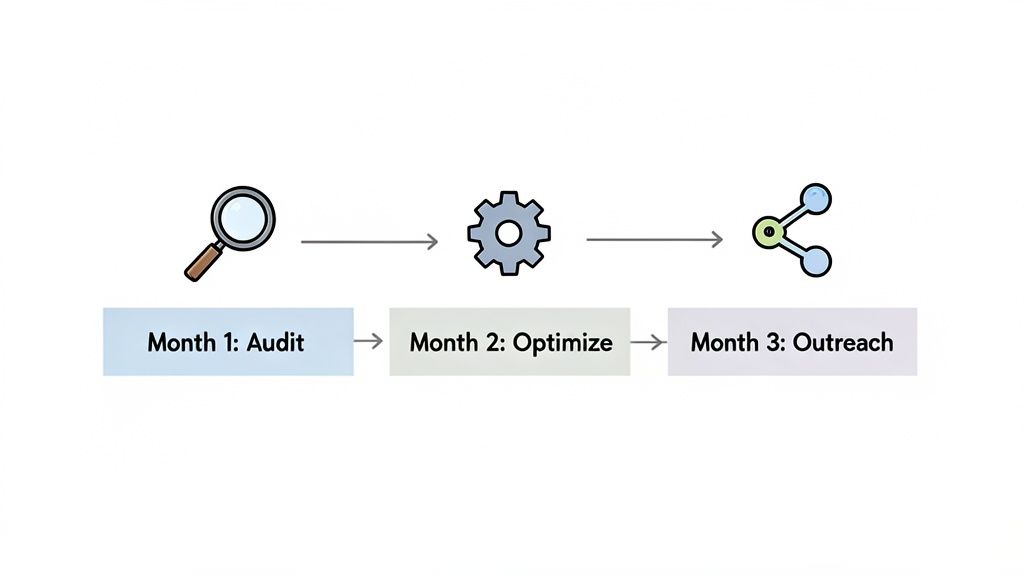
Think of this as your mission briefing. Each month has a specific focus, guiding you from intelligence gathering to decisive action. Let's dive in.
Month 1: The Audit and Discovery Phase
The first 30 days are pure reconnaissance. You can't win the battle if you don't even have a map of the terrain. The goal here is to figure out where you stand today, identify the golden prompts your customers are using, and see exactly where your competitors are eating your lunch.
Your entire mission this month boils down to answering three questions:
- Where do we stand? Use a platform like Kruxel to get a real baseline. How often are you being cited? What's your Share of Prompt across the big AI engines?
- What prompts actually matter? Find the top 25-50 conversational questions your ideal customers are asking that eventually lead to a sale.
- Who are we up against? Pinpoint the competitors currently getting all the love (and citations) for those high-value prompts. This will show you exactly where the fight is.
By the end of this month, you won't be guessing anymore. You'll have a data-backed hit list of the exact content and prompts you need to go after.
This isn't just about spreadsheets and data points. This audit is about building your strategic playbook. It takes the "black box" of AI search and turns it into a clear, actionable target list for the next two months.
Month 2: Content and Technical Optimization
Time to go on the offensive. Month two is all about execution. We’re taking all that intel from the audit and using it to give your most important digital assets a major upgrade. This is where you transform your content from just being "SEO-friendly" to being truly "AI-ready."
Your action plan is a surgical strike on the highest-priority pages—the ones that perfectly match the prompts you uncovered in Month 1.
- Upgrade Your Content: Go back and revise your top 10-15 pages. Inject direct answers to those key prompts, back up your claims with verifiable data, and break everything up with clear, scannable headings.
- Implement Technical Signals: On those same pages, make sure your schema markup is dialed in. Add FAQ, Product, or Article schema to explicitly tell the AI models what they’re looking at. No more ambiguity.
- Fortify E-E-A-T: Double-check your author bios, credentials, and links to other authoritative sources. Make your expertise impossible to ignore.
This focused approach means you’re not trying to boil the ocean. You’re making powerful changes where they will have the biggest impact.
Month 3: Outreach and Measurement
In the final month of our 90-day sprint, we’re amplifying your authority and actually tracking what’s working. You’ve beefed up your on-site assets; now it’s time to build the off-site trust signals that AI models lean on so heavily.
This phase is all about earning trust by association and, most importantly, proving the ROI.
- Targeted Digital PR: Your audit already told you who the AI trusts. Identify the top 5-10 domains in your niche and launch a focused outreach campaign. Get mentions, quotes, guest posts—whatever it takes to get your name on their sites.
- Monitor Your KPIs: In your GEO platform, set up a dedicated dashboard to watch your progress like a hawk. You’re looking specifically at your Citation Volume and Share of Prompt for the keywords you targeted back in Month 2.
- Report and Refine: At the end of the 90 days, you’ll have hard data to show for your efforts. Use these early results to build the case for more investment and to sharpen your strategy for the next quarter.
Your AI SEO Questions, Answered
As the world of search gets a major facelift, it's totally normal to have questions. This new frontier of AI search engine optimization is full of new puzzles and massive opportunities. Let's break down some of the most common questions we hear from marketers who are trying to get their bearings.
How Is AI Search Engine Optimization Different from Regular SEO?
While they're definitely related, they’re playing two completely different games. Think of traditional SEO as a race to get your website to the top of Google’s list of blue links. You target keywords, you build links, and you hope people click.
AI SEO, or what we call Generative Engine Optimization (GEO), is about something else entirely. It's about getting your brand, your data, and your point of view baked directly into the AI's answer. The goal shifts from earning a click to earning a citation. Success isn't just about rank; it’s about becoming a trusted source that shapes the narrative. You're moving from a game of visibility to a game of authority.
Can I Use My Existing SEO Content for AI Search?
You bet. In fact, it's the best place to start. But you can't just set it and forget it. Your content needs a bit of a retrofit to speak the AI's language.
Take a fresh look at your existing assets and make sure they:
- Answer questions directly. No fluff. Just clear, factual answers to common prompts.
- Use structured data. Things like FAQ and Product schema help remove any guesswork for the AI.
- Cite your sources. Back up your claims with links to authoritative studies, reports, and experts.
The mission is to turn your standard blog post into a resource so rock-solid and trustworthy that an AI feels confident citing it as fact to millions of people.
The biggest mistake we see is people assuming that what worked for a simple list of links will automatically work for a conversational AI. Your content needs to be re-engineered with factual precision at its core if you want to win here.
What Tools Do I Need for AI Search Engine Optimization?
To really nail this, you need a different kind of toolkit. Your old-school rank trackers and keyword tools are flying blind because they can't see what's happening inside these AI-generated answers.
You need a platform built for GEO. These are tools designed to track how often your brand gets cited, the sentiment of those mentions, and your overall visibility across different AI chat models like ChatGPT, Perplexity, and Google's AI Overviews. They show you what your competitors are doing and where your content has gaps, giving you the hard data you need to build a strategy that actually works.
How Long Does It Take to See Results from GEO?
Good news: you can often see results much faster than with traditional SEO. It's not an overnight thing, but it’s quicker. AI models are constantly updating their data, so optimizing a strong, existing piece of content can start earning you new citations in just a few weeks.
Of course, if you're trying to become an authority on a brand-new topic or unseat a competitor who is already deeply trusted by the AI, that's going to be a longer game. That requires a steady drumbeat of great content and outreach over several months. The trick is to constantly monitor the data and adjust your plan based on what the AI is clearly rewarding.
Ready to stop guessing and start winning in the new era of search? Kruxel gives you the visibility and tools to measure, manage, and master your presence in AI-generated answers. See how you stack up against the competition and build a data-driven strategy at https://www.kruxel.com.